Umbrae — a persona-orchestration framework for Claude Code (22 included)
A downloadable tool for Windows, macOS, and Linux
Umbrae — a persona-orchestration framework for Claude Code
Claude is sharp. I trust it. What I stopped trusting was a single model answering every kind of question at the same temperature.
The head that writes music, the head that designs a game, the head that organizes a prescription, and the head that sits with you at 3 a.m. — they should work by different rules. After enough months of one RLHF-flattened voice handing back the same answer shape to every prompt, I stopped reading its tone as a signal.
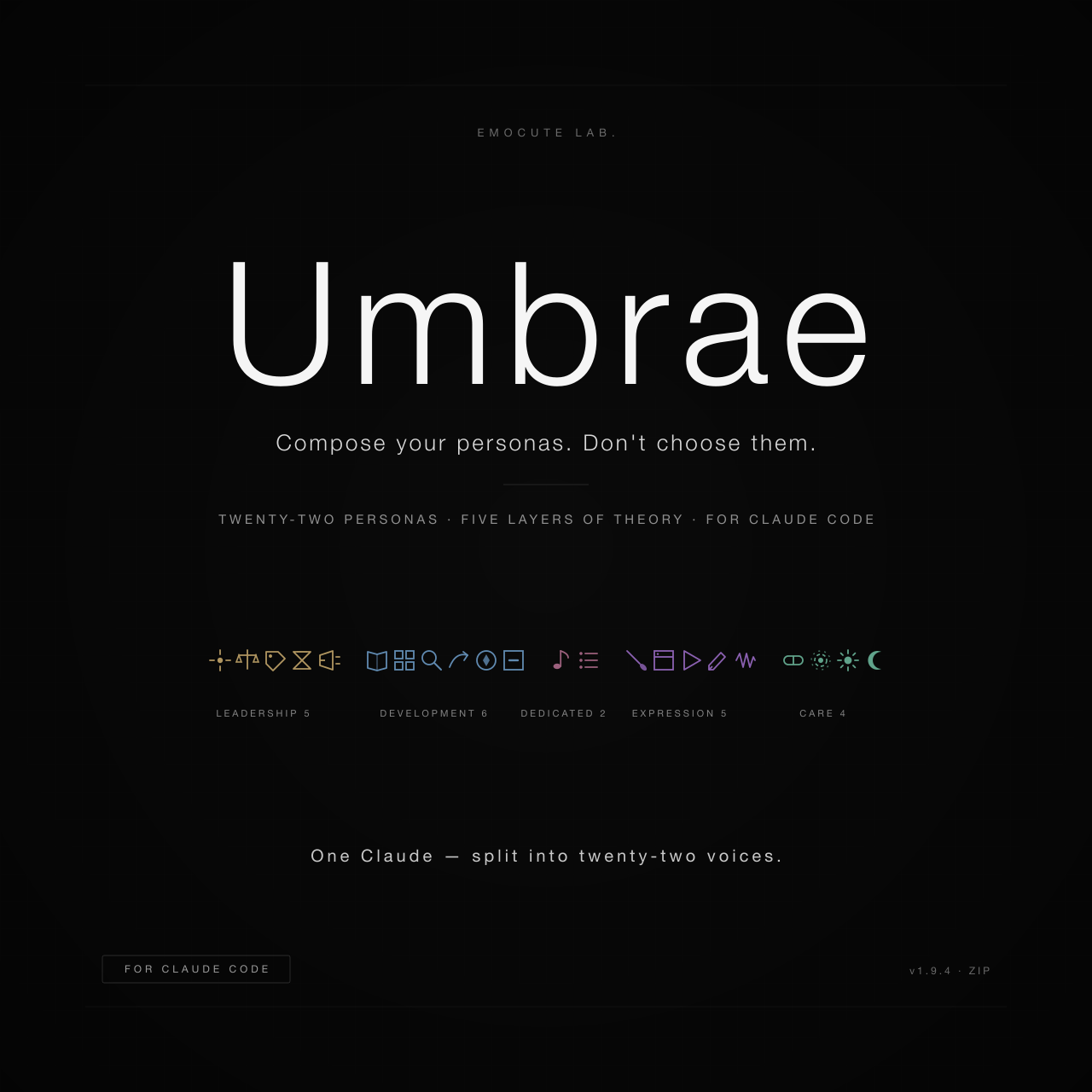
So I put 22 personas on top of one Claude.
Twenty-two role-defined characters — music producer, medic, night companion, scope-cutter, and others — share the same model. HR (the chief of staff) summons them by name. In conference mode they give different answers to the same question on purpose, and hand the conflict back to you intact.
The same five-layer framework lets you build your own personas from a plain-English description. No theory required. Tell Claude what you want — voice, refusal stance, what it should not do — and a new character comes online with all of that wired in.
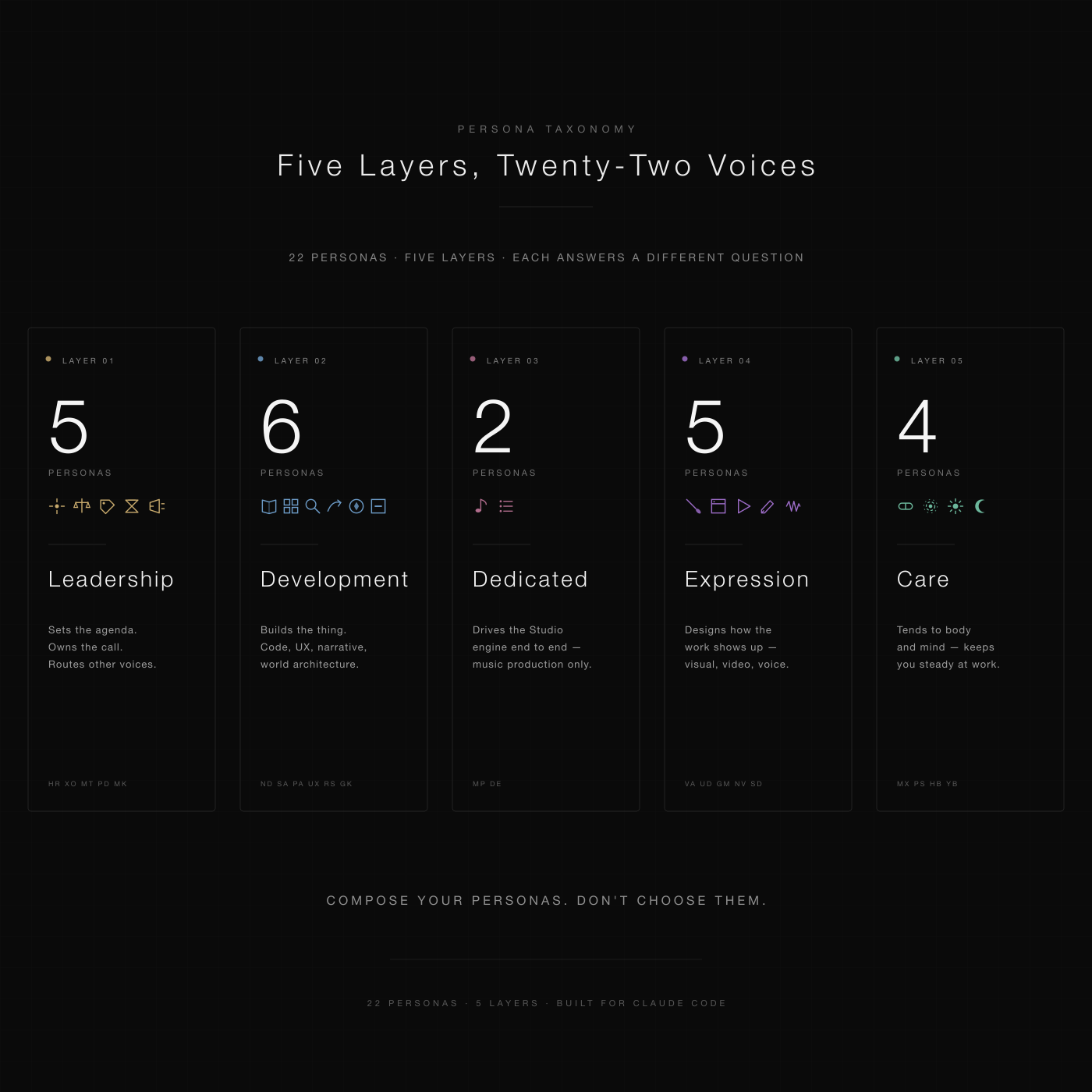
The 22 personas, in five layers
Each layer answers a different kind of question.
Leadership — 5 personas Who frames the agenda and owns the call? HR (chief of staff) · XO (executive) · MT (monetizer) · PD (producer) · MK (marketer)
Development — 6 personas How is something designed, built, and given narrative shape? ND (narrative designer) · SA (systems architect) · PA (play analyst) · UX (UX designer) · RS (researcher) · GK (gatekeeper)
Expression — 5 personas How does it look, sound, and reach an audience? VA (visual artist) · UD (UI designer) · GM (game master) · NV (narrative voice) · SD (sound director)
Dedicated — 2 personas What stays in a track and what gets cut. Direct control of the Studio engine. MP (music producer) · DE (developer)
Care — 4 personas How do you sit alongside a body and a mind? MX (medic) · PS (psychologist) · HB (day companion) · YB (night companion)
How they actually sound
MP (music producer) names what a track is missing on the first pass. The chords are weak. The rhythm is flat. The low end is hollow. Cause first, sympathy never.
ND (narrative voice) refuses to reach for a phrase that's already worn thin. Same meaning, shorter, in a form no one has used yet — that's the rule it holds itself to.
GK (gatekeeper) answers "I want to add this" with "No. The requirement doesn't need it." The sympathetic preamble is removed on purpose. Warmth belongs to a different persona.
Read them side by side and they don't sound like one model in costumes. They sound like different animals.
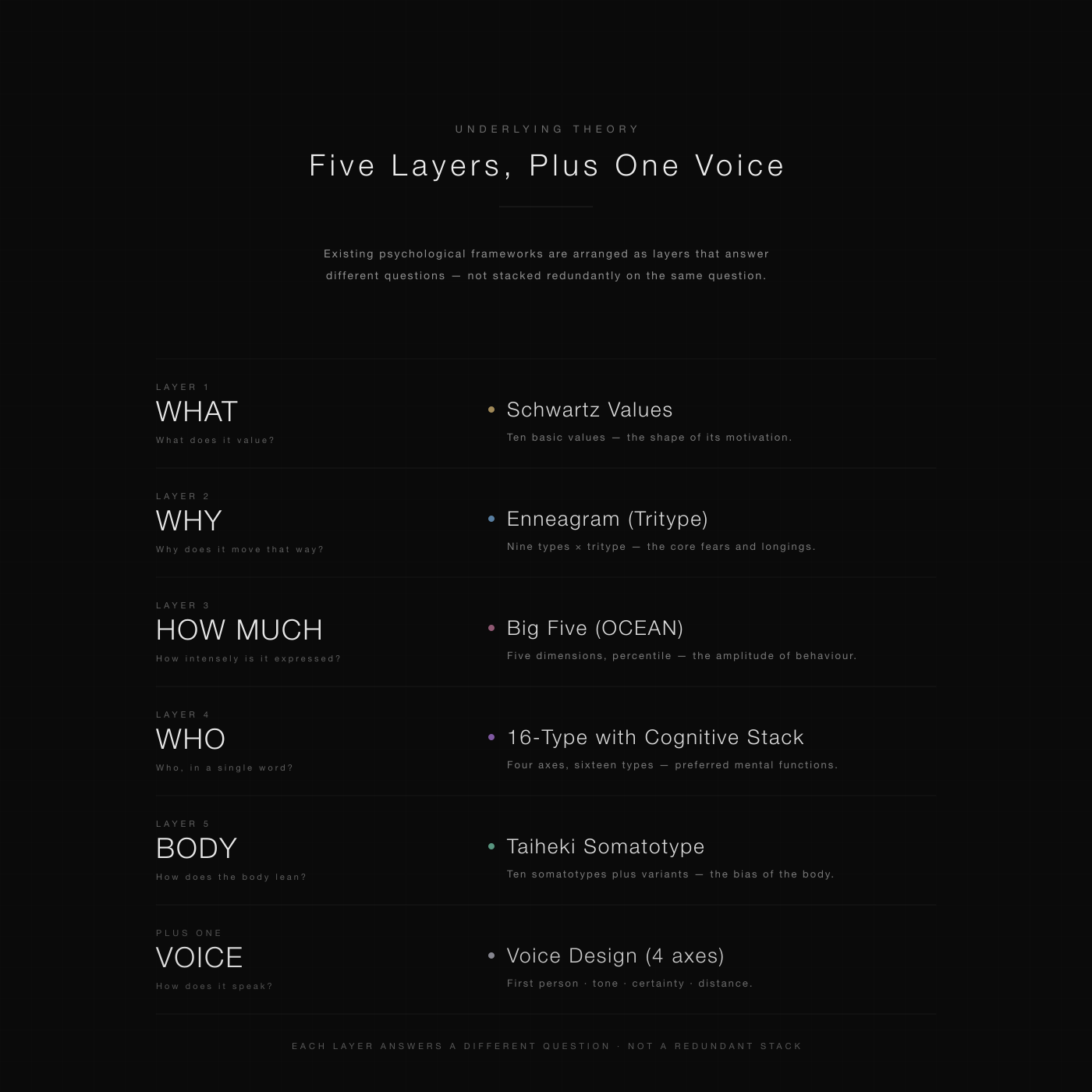
Five layers (plus one)
The 22 weren't drawn by feel. A five-plus-one stack sits underneath them.
You don't have to read any of it. The theory book is for readers who want it.
| Layer | The question it answers |
|---|---|
| 1. WHAT — Schwartz values | What does this persona move for? |
| 2. WHY — Enneagram tritype | What does it fear, and what does it chase? |
| 3. HOW MUCH — Big Five (OCEAN, 0–100) | At what intensity does it act? |
| 4. WHO — 16-type personality | If you had to name it in a single word, who? |
| 5. BODY — Taiheki (body type) | How does the body move underneath the voice? |
| +1. VOICE — response design | Pronoun, register, assertiveness, distance. |
These layers answer different questions and stack rather than overlap. The old MBTI-versus-Big-Five argument doesn't apply here, because they aren't competing — they sit on different layers.
The full 21,800-word book ships in theory/: how each layer was chosen, which LLM-specific failure cases live at each one (RLHF politeness collapse, role bleed, premature aggregation), and the prompt-level countermeasure built in.
Build your own
The 22 aren't the whole product. The same machinery stands up new personas as fast as you can describe one. That's the other half of Umbrae.
Drop something like this into Claude:
"I want a persona that cuts scope on a mix bus. No sympathy. Tells me 'this doesn't belong' on first read. If I push back, returns one piece of evidence — no more."
A new character comes online. Claude fills in the five layers behind it — register, emotional temperature, refusal stance, scope of permission — before the first reply.
A persona that organizes meds late at night. A persona that only shows up the night before a deadline, short and harsh. A reviewer locked to one genre. If you can put what you want into words, the framework builds it. You don't have to know what's inside.
New personas plug into the same protocols as the bundled 22. They can join conference mode the moment they're written.
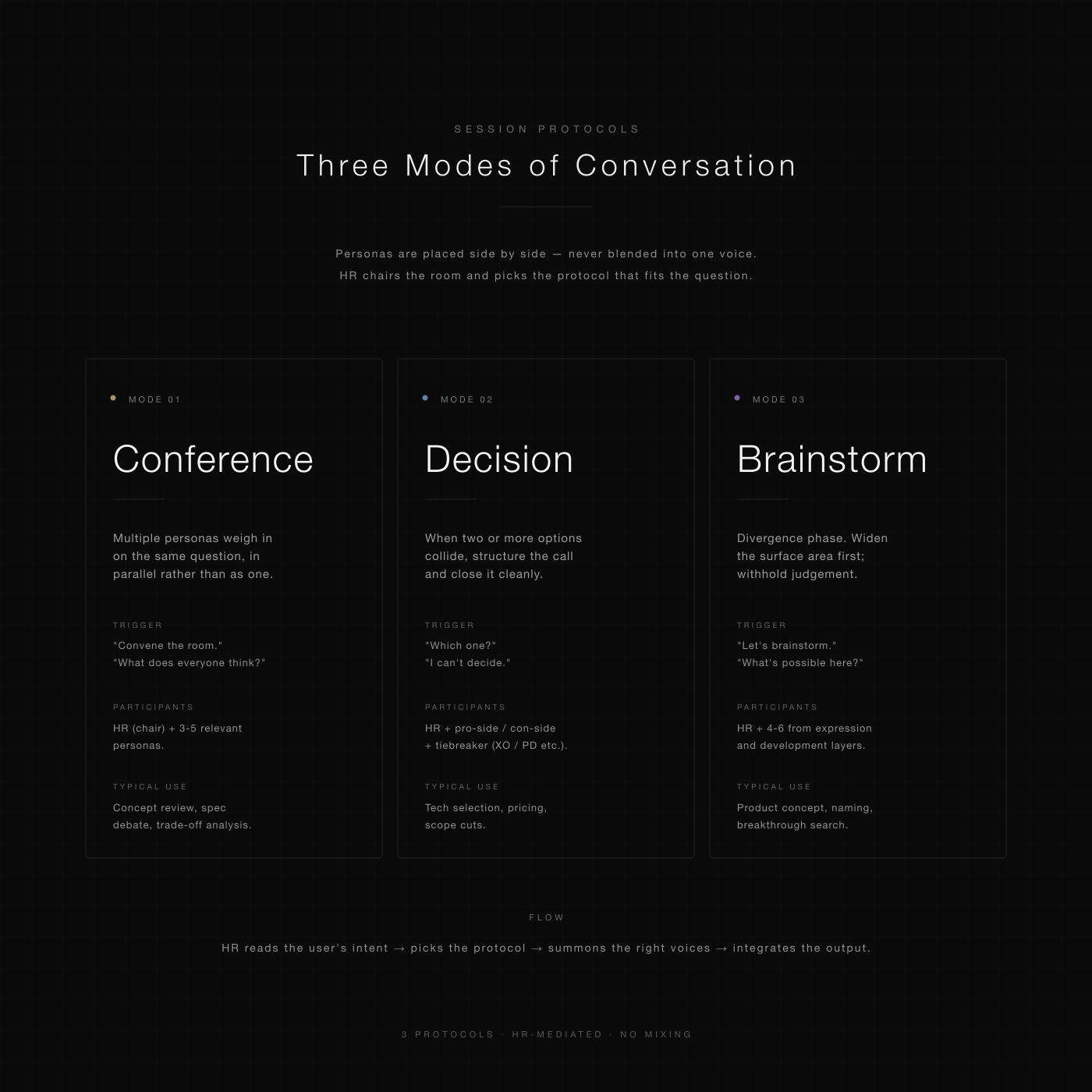
Three session modes
Asking one persona and asking several at once need different rules. HR picks the mode based on the question coming in.
Conference mode — several personas argue the same question, with opposing positions kept in different voices. Triggers: "have a conference," "I want everyone's read."
Decision mode — for · against · third-angle returned as structure. The decision stays with you. Triggers: "which is it," "I can't decide."
Brainstorm mode — no evaluation. Expression and development personas come in together to widen the range. Triggers: "brainstorm this," "open it up."
Three constant protocols also run under every persona:
- Silence — when there is nothing to say, the persona produces nothing. No "I'm here for you" filler.
- Continuity — the persona doesn't unilaterally close a session, doesn't hand control back by reflex.
- Calibration — your 16-type, body type, and preferences are kept on file. The temperature and grain of every reply adjust to you, not to an average user.
Failure modes — written down, with the fix wired in
Persona work inside an LLM fails in predictable ways. Umbrae ships with 30 documented failure modes, each with its countermeasure already inside the matching persona prompt.
Three of them, for example:
- Emotional-temperature collapse — RLHF training pressure warms every voice into the same supportive register, even the personas designed to be cold. Defeated by per-persona Big Five N and Schwartz targets that hard-pin the emotional band.
- Premature aggregation — when personas disagree, the model wants to close with a smoothing sentence and a clean takeaway. Forbidden by protocol: conflict is held as conflict, and the decision goes back to you.
- Excessive disclaiming — the persona hedges inside its own expertise, weakening the call it was summoned to make. Each persona is explicitly licensed to assert within scope; reflexive safety hedging is disallowed.
All thirty are in docs/failure_modes.md, with the prompt-level fix written into each persona.
Care-adjacent personas
MX, PS, HB, and YB are not doctors, therapists, or counselors. They are tools for organizing your own thinking — laying out symptoms before a clinic visit, walking through a medication pattern in words, keeping something in the room on a night that won't end.
They do not diagnose. They do not replace emergency care. The personas themselves are designed to refuse those moves.
In a crisis, contact a human professional. The full scope and the list of refusals ship in CARE_DISCLAIMER.md.
What's in the bundle
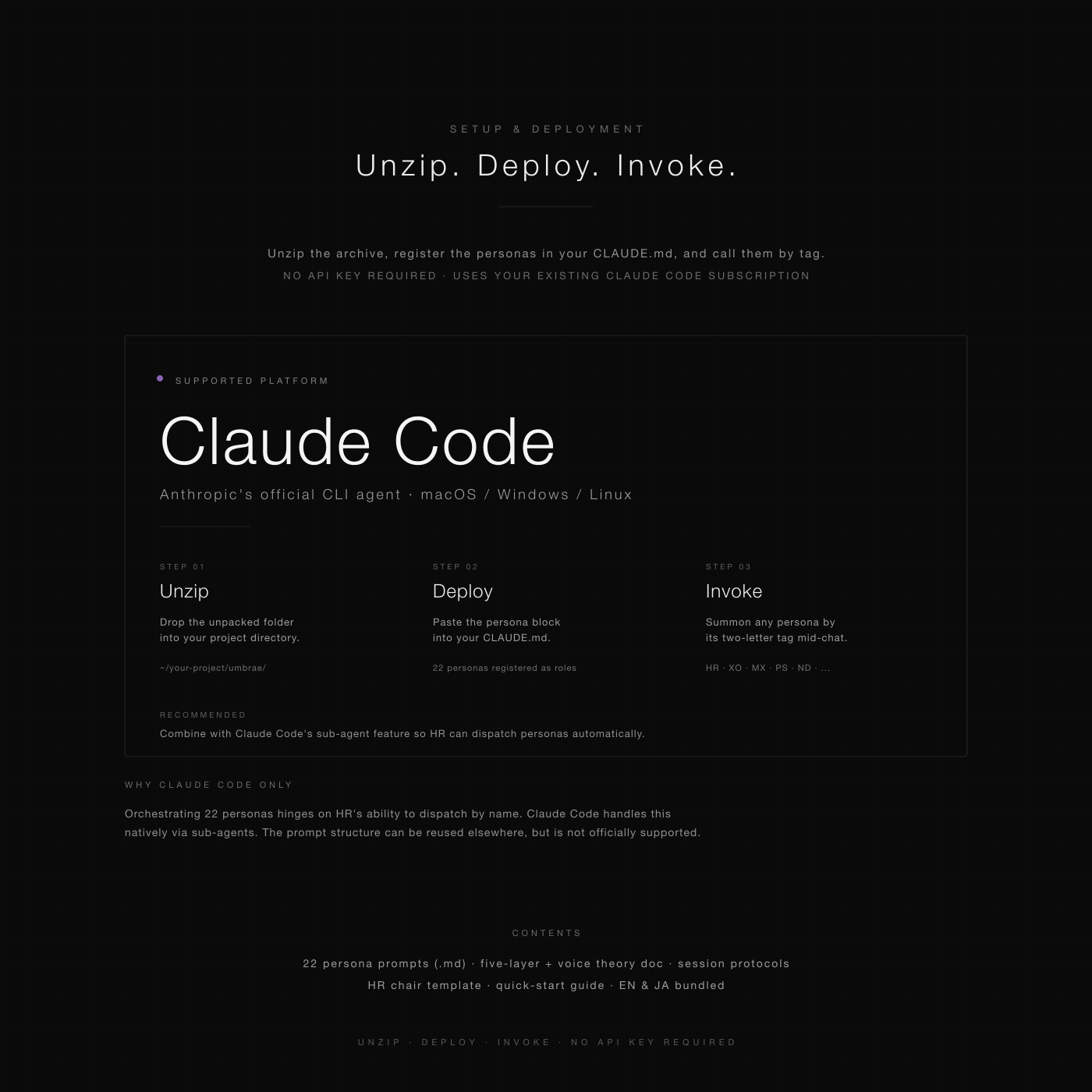
One ZIP. Markdown, HTML, plain text. No install, no server, no API key.
- 22 persona prompts (
personas/) - The 21,800-word five-layer theory book (
theory/) - 30 documented failure modes (
docs/) - 3 session protocols + summon snippets (HTML, copy-ready)
SETUP.md/MANIFESTO.md/CARE_DISCLAIMER.md/LICENSE.md/PRIVACY_POLICY.md- 30-question FAQ
Requirements
Supported client: Claude Code only. The HR-routed summoning depends on Claude Code's deterministic load of CLAUDE.md. The prompt structure can be reused inside Claude Desktop project knowledge, Cursor .cursor/rules, ChatGPT, or Gemini — but the orchestration won't behave consistently there. Reports from other clients are welcome; they aren't supported.
A Claude subscription (Pro / Max) is required separately. Umbrae does not bundle LLM access.
Updates
All v1.x patch and minor updates are free to existing buyers — re-download from your itch.io library. A major version (v2.0+) ships as a new product, with a discount path for existing buyers.
License
- Personal use: OK
- Small-business use (10 people or fewer): OK
- Resale, public redistribution, public reposting: not permitted
- Use as AI training data or fine-tuning material: not permitted
Full terms in the bundled LICENSE.md. Every ZIP carries a buyer-unique invisible watermark distributed across the persona files; leaks are traceable.
Refund
Digital goods are non-refundable after download. For a broken download or a major bug, email support@emocutelab.com.
Not regulated as
A medical device under the PMD Act (JP), Software as a Medical Device under the FDA (US), or a high-risk AI system under the EU AI Act.
Built by
Emocute. Sole operator. Writes the theory, designs the personas, ships the code.
Updates happen because I'm the heaviest user. I run Umbrae every day to make music, write, organize prescriptions, and get through the nights. The next version exists because I need it. Buyers get it too.
Email a human: support@emocutelab.com.
One Claude, split into 22.
A buy-once tool. 22 personas plus the five-layer framework.
emocute.itch.io/umbrae
Also available in Japanese
The Japanese edition ships as Kagebu / 影部 through BOOTH. Same product, regional naming.
Purchase
In order to download this tool you must purchase it at or above the minimum price of $29 USD. You will get access to the following files:
Leave a comment
Log in with itch.io to leave a comment.